Introduction
Regardless of how we feel about the cause for which he fought, Thomas "Stonewall" Jackson was indisputably an excellent military commander. While he earned his fame by "standing like a stone wall...with his Virginians" at First Bull Run and was a key contributor to the more famous and numerically larger victory at Chancellorsville, perhaps his greatest achievement as a military leader was his performance during his 1862 campaign in the Shenandoah Valley. While much has been written of the detailed events of the campaign, Jackson's eccentricities, religious fanaticism, and the genius of his military tactics, I find it interesting to explore the interplay and relative importance of his religious beliefs and the conduct of tactics that ultimately won the day. In this essay I will argue that, while his success in the Valley Campaign was the result of a number of different factors, it would not have been possible without his religious fanaticism. His absolute faith provided him with a construct that allowed him to partition his thinking by drawing clear boundaries between what was within his control vs. what was outside of it, thereby removing a need for the types of doubt and second guessing that litter the histories of the blunders of other Civil War generals.
Finally, I will discuss what I think may be alternative methods that modern leaders might leverage to achieve the type of focus and freedom from emotion that Stonewall wielded, but without having to resort to a blind faith in a first century carpenter.
Background for Valley Campaign
The backdrop for Jackson's Valley Campaign was General George McClellan's famous "Peninsula Campaign", in which the latter ferried over 100,000 soldiers down the Potomac to Hampton Roads and moved up the peninsula with the aim of taking Richmond. McClellan vastly outnumbered Joseph Johnston's (and eventually Robert E. Lee's) forced defending the Confederate capitol. Jackson was initially dispatched to the Shenandoah Valley in late 1861 due to it's strategic importance to the Confederacy due to it's abundance of much needed livestock and agricultural supplies. However, his campaign there in Spring 1862 was ultimately significant for the diversion it created to keep Federal troops from being able to join McClellan's outside Richmond during his Peninsula Campaign. As an advisor to Jefferson Davis at the time, Robert E. Lee saw the threat of Gen. Irwin McDowell joining Gen. George McClellan and conveyed the situation to Jackson and told him the potential benefit to the broader military situation if he could present a threat to Washington, DC near Harpers Ferry. Jackson eventually gathered a force of around ~17,000 men compared to a total of around 52,000 that eventually opposed him in the Shenandoah Valley under Banks, Fremont and McDowell. Over the course of just 48 days, Jackson forced his men to march a blistering 646 miles, typically under detailed instructions to march for 50 minutes out of each hour and to spend the other ten minutes prone to maximize resting. He seems to have personally slept rarely, moving with his men by day and studying his detailed maps at night in order to constantly adapt his strategy. He outwitted and surprised his numerically superior opponents on multiple occasions and ultimately won several minor battles, capturing hundreds of prisoners, large amounts of supplies and completely routing Nathaniel Banks' army and sending it's soldiers fleeing back across the Potomac towards D.C. The ultimate result was exactly what Lee had hoped for and, by occupying McDowell in the north, Jackson prevented him from reinforcing McClellan and may well have saved Richmond from falling less than two years into the war. Abraham Lincoln himself is known to have been acutely aware of Jackson's skill in the Valley Campaign, as he was personally involved in developing Federal plans to counter him.
The Plight of a Civil War General
If one is to study the exploits of Civil War generals with an aim of learning lessons about what makes for a successful military leader and tactician, it seems relevant to consider just how different the situation was for Civil War generals relative to modern military leaders. In particular, the typical Civil War general had to operate with far more limited communication abilities and vastly more limited intelligence sources, both in quantity and quality. The Northern and Southern governments certainly did what they could to cultivate intelligence sources, but even at its best it was far more limited than what todays leaders often have to rely on. There was no satellite surveillance or GPS navigation. When maps were available, they were not always current or accurate. Even when an informant arrived claiming to have personally witnessed an enemy movement or position, they lacked what we now consider a the simple technological miracle of being able to see proof of this report in the form of photographic evidence taken with a smartphone.
They also often lacked the benefit of immediate bi-directional communication with their superiors, peers or supporting elements. On the day of a planned assault, one general might be charged with waiting to hear the thunder of distant cannons to judge whether an allied unit had arrived and initiated their own assault, thereby indicating that their own attack should commence. Once they were engaged, they could expect significant latency if they needed to get in touch with their superiors, if such communication was even possible at all. For Jackson during the Valley Campaign, he would typically have been days away from reinforcements as well as days from being able to get a message to Richmond, let alone to then get a response. In the midst of a battle, generals like Jackson were often severely limited in their ability to comprehend the status of their full command due to the simple constraints of line of sight and delays in communication. For example, during the peninsula campaign McClellan was sometimes known to have personally climbed a tree with the hope of getting a better vantage point. The constant dearth of basic battlefield intelligence was, in fact, what ultimately led to Stonewall's death at Chancellorsville -- with the desire to mount a night attack and finish off the union forces, he rode out beyond the lines with his staff officers to personally scout for a night attack and was shot down by nervous Confederate pickets who mistook his party for the enemy when they returned to the lines.
An obvious effect of the lonely nature of being a Civil War general was the rollercoaster of disastrous defeats and heroic victories that makes studying the war so entertaining for many students and historians. However, I find this dynamic makes for an especially interesting opportunity for a focused study of how specific individuals performed under adversity and in a communication vacuum. Unlike today's leaders who can always rely on making a satellite or radio call to allies, superiors, or advisors, Jackson's isolation shines a spotlight on how his individual beliefs, attributes and personality contributed to battlefield outcomes.
About Jackson
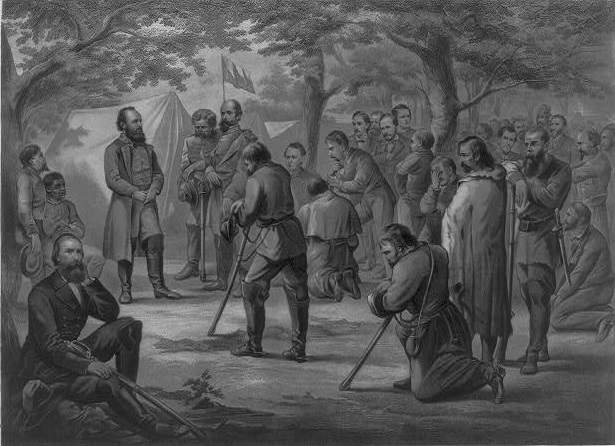
In the interest of brevity, I will refrain from providing extensive biographical information about Stonewall Jackson. For those who are not already familiar with him, I highly recommend reading Shelby Foote's masterpiece or watching Ken Burns' documentary "The Civil War". Or, if you're short on time, check out the wikipedia page on him. However, it is important to note some key facts about him. First and potentially foremost, he was a religious fanatic. His beliefs were present in everything he did--the way he communicated to his superiors and his men, the way he fought his battles (and when he fought them), and his attitude towards death and killing. They even influenced the way he died, when he refused to take brandy for the pain when he lay dying from pneumonia after the amputation of his arm, saying that he wanted to keep his mind clear for when he went to meet the lord. When his wife and doctor informed him that he would die that day, he replied "Very good, very good. I always wanted to die on a Sunday."
He was a trained soldier and military leader, having graduated from West Point and working as a teacher at the Virginia Military Institute prior to the war, but his military exploits were far from being "by the book". He was daring and versatile, remaining calm in the face of opportunity and dire threat, whether that threat was of being surrounded by adversaries or personally standing like "a stone wall" in the face of enemy fire. He was ruthless towards the enemy and saw the killing of his opponents in a way that seems to have been purely tactical and non-emotional. He was also rarely known to react emotionally to the deaths of his own men, although he was acutely aware of his need to preserve as many of his limited forces as possible for tactical and strategic value.
The Ingredients in Jackson's Recipe for Success
By his own account, Jackson would surely have listed "God's blessing" as the primary cause of his success, as he did shortly after the fact in writing to his wife that "God has been our shield and to his name be all the glory." While he was keen to give the credit to "divine providence", he was also brilliantly capable of distilling some of the core tactical and strategic "rules" that he had employed in achieving the outcome that "providence" had given him. He said the following to one of his adjutants:
Always mystify, mislead and surprise your enemy. And when you strike and overcome him, never let up in the pursuit so long as your men have strength to follow, for an army routed, if hotly pursued, becomes panic stricken and can then be destroyed by half their number. The other rule is never fight against heavy odds if by any possible maneuvering you can hurl your own force on only a part—and at the weakest part—of your enemy and crush it. Such tactics will win every time and a small army will thus destroy a large one in detail and repeated victory will make it invincible.
Jackson's rules could certainly fit right into a textbook on sound military doctrine. However, these rules were not exactly foreign to many other Civil War leaders on both sides. It's hard to imagine McClellan or Grant choosing an alternate approach if faced with similarly inferior numbers. What's more interesting to me is what allowed him to stay focused on a day-to-day basis and avoid the tendency for second guessing that so famously plagued other generals like McClellan or Jackson's opponent at Chancellorsville, Joe Hooker, who after the battle admitted that he had "lost confidence in Joe Hooker".
Beyond the military principals found in Jackson's rules above, there were a number of other factors that, if missing, could have changed the outcome of the campaign.
1. His confidence and ability to take risks with conviction and no hesitation
It's one thing to believe in your heart that you need to "mystify, mislead and surprise your enemy". It's another to pull it off, especially when operating in a communication vacuum with limited intelligence.
2. His ability to push his men beyond what more compassionate generals might have considered to be their limit
Out of necessity, Jackson pushed his men to march unusually hard and long in order to out-maneuver and surprise his opponents. So much so that they began to be referred to as "Jackson's foot cavalry". He kept a cool aloofness from the rank and file, showing no sympathy for men who collapsed from exhaustion. When told that a runner had died from enemy fire when delivering a message for him, he simply replied "very commendable, very commendable", and calmly moved on with what he was doing. This degree of cold, emotionless leadership was far from the norm among Civil War generals. Lee often appealed to emotion and the deep love his men developed for him. McClellan told his troops he saw it as his duty to look after them like a parent. Grant perhaps came closer during his Overland Campaign in 1864, but he was known to be capable of deep remorse and emotion at the loss of his men.
3. His own personal endurance
He doesn’t seem to have been much for sleeping. I suspect he had an ability to not sleep much and instead be able to stay up studying his detailed maps and hatching plans.
4. A healthy dose of luck, coupled with an eye for recognizing opportunities and a presence of mind to move quickly to exploit them
Yes, there certainly were lots of lucky moments and events. Some include well timed rainstorms and hailstorms. These presented a variety of benefits, such as swelling rivers but also being so extreme that any normal general would consider them a reason to halt a column. But not Jackson. He saw the “hail the size of a hens egg” as a blessing that would allow him to push his men to take the literal bruises and march through it while the enemy hesitated.
5. His ability to have no hesitation when it came to killing the enemy
He was clear minded and untroubled by his conviction that his objective was to destroy them. I suspect his religious views served a purpose here as well. It must have been a mechanism that let him simply put sympathy and hesitation out of his mind. At one point during the Valley Campaign, one of his subordinates reported having successfully defended against a cavalry charge but stated that it was a shame to have killed Union troops who had demonstrated such bravery. Jackson reproached him, making it clear that that he wanted as many dead as possible so there would be that many fewer to fight him next time.
6. A genuine love of battle that was unmitigated by emotions like fear and sadness
It does also seem relevant that he genuinely seems to have loved battle. I suspect he liked the adrenaline rush and accompanying mental focus. However, his religious fervor once again seems likely to have been relevant here as well. For most people, the thrill of battle is balanced by other emotions such as confusion and a horrible fear of injury or death. Jackson had complete faith that there was nothing to fear about the Heaven that awaited him, leaving him to bask in the adrenaline high of combat.
Credit for his successes has often been attributed, in part, to the fact that he had large, detailed and extremely accurate maps of the theater that his opponents did not have access to. For example, Ken Burns and Shelby Foote both note this in their respective histories on the subject. However, I have not included this factor in the list above because it's not clear to me that he would have failed if he had only had somewhat less detailed maps. It seems possible that he could have compensated for shortcomings of inferior maps either by leaning on his resourcefulness, quick thinking, and the likely presence of Virginian soldiers in his force who knew the terrain.
The Role of Jackson's Religious Fervor
In addition to the list of factors documented above, I would argue that his deeply held religious views were also a factor that contributed to his success. Furthermore, I would argue that, while his intelligence, tactical brilliance, famously excellent maps, and luck were all necessary factors, they may not have been enough without adding his religious fanaticism. Were he alive today, I could imagine that Jackson himself would claim to see "the hand of God" in each of the other factors.
I suspect it let him have the mental safety to let go of things outside his control by telling himself they were up to the almighty. That way he’s able to take risks without constant second guessing himself and gave him an ever-at-hand defense against emotions like fear or compassion that might cloud his judgement. It's not difficult to imagine the types of questions that the average person might have struggled with if they found themselves in Jacksons position. Imagine you had four hours to try and get some sleep between two twenty hour days of marching--on a knife edge between disaster and potential victory. Might your sleep-deprived, adrenaline soaked brain have spiraled through the plethora of totally reasonable questions on which your plan depended? "What if the Fremont and Shields didn't stop marching during the hailstorm either and are closer than I hope? What if Ewell's troops don't show up in time to allow my plan to come together? What if hundreds or thousands of my men end up dying if I make the wrong decision?! How will I ever forgive myself if I make a judgement error that causes the destruction of my command!?" It certainly makes it easier to focus on what you can control and on taking decisive action if you can fend off such questions by remembering that those things are "up to divine providence" and that, if anything, you'd be insulting God by spending time stressing about them as though you didn't trust him to deliver you to whatever outcome he sees fit.
His religious faith would have allowed him to compartmentalize things so he could stay laser focused on what was in his control. Without this tool, he might not have been able to quickly capitalize on the noteworthy instances of luck that came his way, to ignore the complaints of his exhausted troops (some of whom were literally passing out on the march), and to accomplish so much in 48 short days without getting distracted by the overall dire state of Confederate military affairs at the time.
One could perhaps question whether my arguments above are assigning too much credit to his religious fervor without any good way to know for sure what really was going on in Jackson's mind. What if he was just one of those people who don't really get anxiety? Maybe he was just really good at clearing his mind and focusing? It is possible that he simply had the type of mind that was exceptionally good at decisive action and immune from emotion and second guessing. In fact, to some extent that was likely the case regardless of the role of religion. However, a litany of primary sources make it clear that his religion was one of the things that defined him and was present in almost everything he ever wrote or said. His was an "army of the living God" and he was known to have said that "my religious belief reaches me to feel as safe in battle as in bed." Given the degree to which history has documented his Presbyterian fervor, I believe that we can conclude that it was a part of the bedrock of his mental framework.
So What? Should we All Become Presbyterians?
In the case of Stonewall's Valley Campaign (as well as some of his other exploits), it seems that his ability to lean on his faith for focus largely served as an asset. However, it is important to recognize that it was an asset only because he managed to use it to the right effect. His ability to relegate emotions and worries about things outside his control into a mental bucket labeled "In the hands of providence - Not worth further anxiety or second guessing" cleared up more space for his skills as a leader, analytical mind and tactical genius to use up more mental bandwidth. Unquestionable faith in a bronze age deity comes with a host of risks and downsides and, in the minds of a lesser general, it could just as easily have been used to rationalize hesitation or retreat. Furthermore, it is generally dangerous to abandon reason and logic in one department of one's mind, as it may become difficult to prevent the tumor from spreading.
The best strategy is without question to invest in scientific and technological advancement, training, education, and any other possible preparation that can help you avoid finding yourself in a strategically inferior position with limited information like that of Jackson in the Shenandoah Valley. It's not hard to imagine that Stonewall himself would choose having superior forces over being left to rely on his "two rules" in the face of an overwhelming enemy force. The United States military has become famously good at managing the odds over the course of the last 70 years. In fact, most modern American military leaders have never experienced a battle in which the US lacked clear superiority. But what if that wasn't always going to be the case? What if a conflict arises in which the opening blows involve the destruction of satellite communication and GPS networks? Might we learn from Jackson's greatest victory to aid us in such a scenario?
While I would strongly advise against resorting to faith in a religion like Jackson's, I do believe there is a lesson to be gleaned from his example that can benefit the modern educated atheist. I would suggest the addition of the following to Jackson's "two rules" that we discussed previously:
When facing heavy odds, limited information and lacking the benefit of being able to delay taking action, it is preferable to be able to quickly distinguish between what is within ones control and to avoid the mental fog that can be caused by letting emotions (e.g. guilt, fear, etc.) run rampant. A leader should take every possible step to gather the best available information and then take decisive action and remain ready to quickly adapt to changing circumstances and new data.
You might reply by saying, "Easier said than done!", and I would have to agree. However, there are non-secular methods that can help. One of the best that I have encountered is to develop the skill of mindfulness. For some, this can be achieved via a regular meditation practice. If you have not already explored the field of meditation and mindfulness, I would highly recommend Sam Harris' "Waking Up" app along with his book of the same title as useful resources. Mindfulness is a tool that, if mastered, can allow you to protect yourself from the mental fog caused by swirling emotions in the face of stress or pressure.
In addition to mindfulness, I contend that one can replace Jackson's blind faith in a Christian God with a firm faith in reason and logic. "Never take counsel of your fears," as Jackson said. Be certain that the future is uncertain, that you will likely be faced with unexpected developments and new challenges and, when they arise, be prepared to use reason and logic to take the next decisive action based on the best information you have available.
Finally, we should strive to ensure that all of our leaders are clear on their objectives and that they are empowered to operate in accordance with their best judgement when it isn't possible to be in constant contact with superiors. Lee (and J. Johnston) followed these principles when giving their orders to Jackson and were greatly rewarded.
Postscript
Personally, I suspect that there is a great deal to be gained via a better understanding of the concept of "free will" and the contention that it is likely to be an illusion. It seems relevant when discussing the topic in this essay. As discussed above, I suspect that Stonewall was using his religious faith as a tool to help him more clearly differentiate between what he could and couldn't control and thereby optimizing his ability to process information and make decisions. The idea that we may lack the "free will" to consciously choose which actions we will take is one that could have profoundly important implications, including when it comes to how we conduct ourselves under pressure. In future essays I intend to explore the topic of free will at length, and may well revisit the conclusions drawn here as a result.
References
- James I. Robertson, Stonewall Jackson: The Man, the Soldier, the Legend (1997)
- Foote, Shelby, The Civil War: A Narrative, Vol. 2
- Burns, Ken. The Civil War
- Shelby, John Millin (2000). Stonewall Jackson as a Military Commander. p 25